
386 - Stop Leaving Speed on the Table: The Bike Fit & Indoor Training Fixes That Actually Work
Follow the Purple Patch Podcast at:
APPLE PODCASTS - SPOTIFY- AMAZON MUSIC - GOOGLE PODCASTS - YOUTUBE
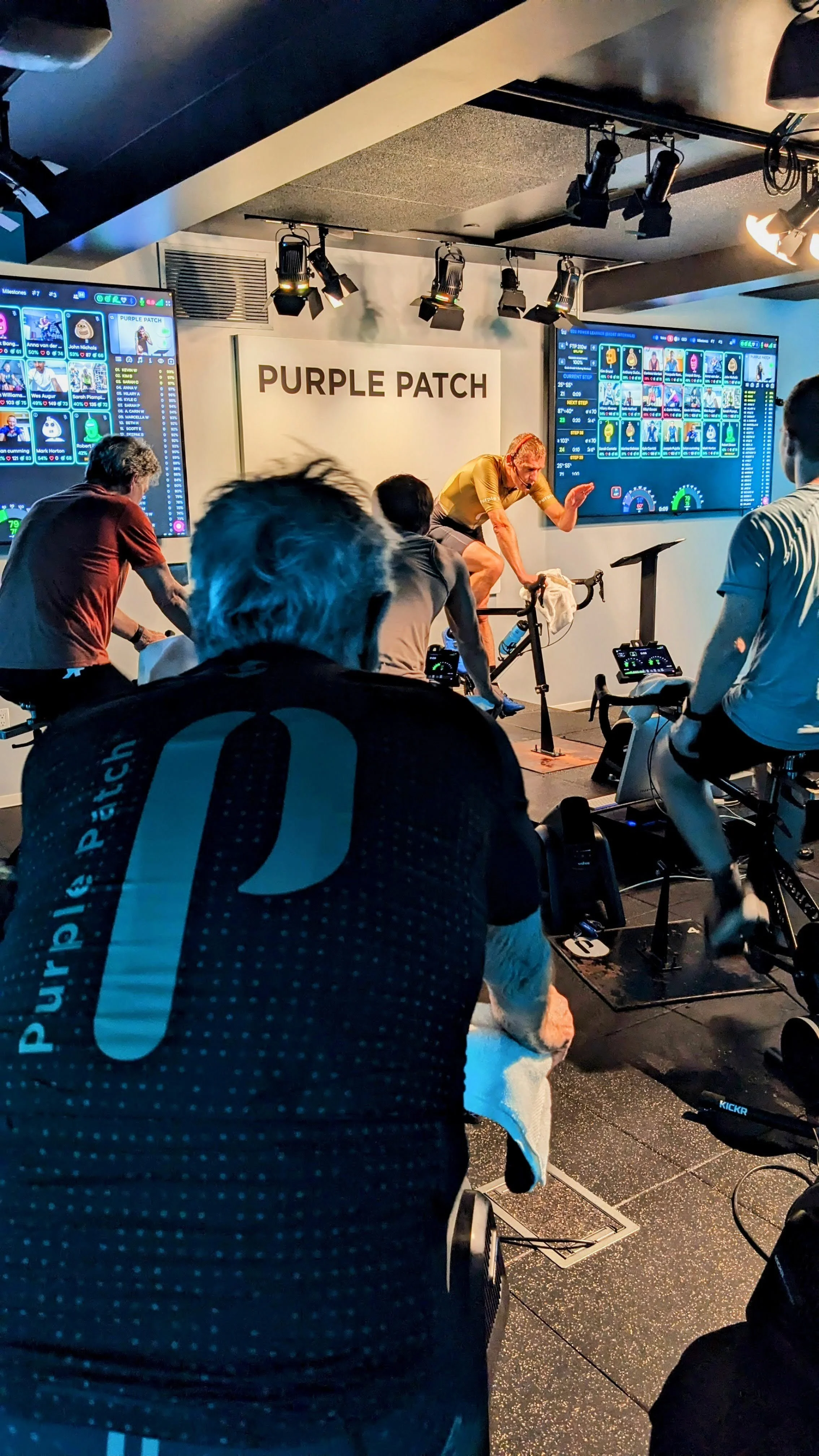
Welcome to the Purple Patch Podcast!
In this episode, Matt Dixon and Chris Soden discuss maximizing winter training for cyclists and triathletes. They emphasize the importance of proper bike fitting, posture, and equipment for indoor and outdoor training. Chris highlights the benefits of using smart trainers and the Velocity platform for effective training, noting that proper form and equipment maintenance are crucial. He advises athletes to document changes and make gradual adjustments. Chris also offers remote consultations and equipment upgrades, stressing the importance of a solid bike position and drive train efficiency. Matt underscores the value of the Purple Patch ecosystem in enhancing athletic performance. If you have any questions about the Purple Patch program, feel free to reach out at info@purplepatchfitness.com.
Episode Timecodes:
Promo: 00-2:23
Intro: 2:52-5:34
Meat & Potatoes: 5:45-end
Purple Patch and Episode Resources
Check out our world-class coaching and training options:
Learn more about Chris Soden & Strategic Fitting: https://strategicfitting.com/
Book a complementary needs assessment coaching call:
https://calendly.com/coaches-purplepatch/offseason-assessment-call
Tri Squad: https://www.purplepatchfitness.com/squad
1:1 Coaching: https://www.purplepatchfitness.com/11-coached
Run Squad: https://www.purplepatchfitness/com/run-squad
Strength Squad: https://www.purplepatchfitness.com/strength-1
Live & On-Demand Bike Sessions: https://www.purplepatchfitness.com/bike
Explore our training options in detail: https://bit.ly/3XBo1Pi
Live in San Francisco? Explore the Purple Patch Performance Center: https://center.purplepatchfitness.com
Everything you need to know about our methodology:
https://www.purplepatchfitness.com/our-methodology
Amplify your approach to nutrition with Purple Patch + Fuelin
https://www.fuelin.com/purplepatch
Get access to our free training resources, insight-packed newsletter and more at purplepatchfitness.com
TRANSCRIPT
Matt Dixon 00:00
Hey folks. Matt Dixon, Here Today's show is a cracker. It's with Chris Soden of strategic fitting, and it is quite wonderful if you're a cyclist, if you're a triathlete, I promise you you do not want to miss this about maximizing your winter session and riding to become a better cyclist. Outside, we go into equipment, we go into position, posture, form and how to maximize your training. It's terrific. There are a few things that I want to go through to help kick off the journey. Number one, if you want to work with Chris directly, we can connect you look for the link in the show notes, or go to the bike fitting section of purplepatchfitness.com you can work with him so far as consulting on equipment, purchasing and getting dialed in for your right fit, even getting a brand new bike. Chris is there your service, and as we mentioned in the show, if you have any questions at all for Chris, send them our way. Info. Purplepatchfitness.com He graciously agreed that he will be happy to answer any of your questions around fitting equipment, whatever it might be, and so feel free to email us directly. Info@purplepatchfitness.com I also want to highlight our bike program. We have a standalone bike program that we discuss in depth at the end of today's show. We spend about three or four minutes it's really worth coming forward to listen to this how for you to become a better cyclist, more confident, calmer in any conditions, and ultimately, faster. You don't need to be a purple patch athlete to leverage this program. It is coaching live on demand for athletes anywhere in the world. And as I talk about it, this is your best ROI, and so I highlight that program. You can find it on the website. It's basically our bike squad, high, high value. And finally, as you listen today, it is the time if you're interested in having any consultation or conversation with us about your coaching journey, feel free to reach out info@purplepatchfitness.com or set up a complementary needs assessment, understand your goals and help you chart a path for you to be successful. It's pressure free. There is absolutely no assumption that you're purchasing a coaching from purple patch. But we do want to help, and so feel free to reach out. We will set you on your path and make sure that 2026, is your best year yet. Info@purplepatchfitness.com All right, enjoy the show. I'm Matt Dixon, and welcome to the purple patch podcast. The mission of purple patch is to empower and educate every human being to reach their athletic potential. Through the lens of athletic potential, you reach your human potential. The purpose of this podcast is to help time-starved people everywhere integrates sport into life.
Matt Dixon 02:51
And welcome to the purple patch podcast as ever your host Matt Dixon and I got to admit today, I thought we're doing bike fitting. Is that going to be a subject that really lands with the listeners? Is this something that we really want to do right now? I invited Chris Soden of strategic fitting. He was on the show before you can go and source that episode. But what has emerged in recording this show is, I think, required listening for any cyclist and triathlete. It's simply a fantastic show around equipment, maximizing your indoor training so that you become a better cyclist, and a step by step guide in how you might invest in better equipment, better posture development, and, of course, better position on the bike. He is a wealth of knowledge is a tremendously entertaining discussion in from one of the world experts in fitting Chris has worked with athletes all over the world of all levels, up to Tour de France cyclists and Iron Man world champions. He is the man, and we are incredibly lucky to have him embedded in the purple patch ecosystem, available as a resource to all of our athletes around the world, but of course, also in the Performance Center in San Francisco, where he has his space. He has more technology than any man I've ever seen. But more than that, he deeply cares with an incredible breadth and depth of expertise. He is the bike fitting wizard, and today is not only personable, interesting, but incredibly insightful. If you want to connect with Chris at all, as I mentioned in the show, there are several ways that you might leverage his expertise. Number one, just have a consultation some of the aspects that you might be considering, where can you make great gains? Number two, actually look at your position on the bike. He can do that remotely. And, of course, he can do it in person. And number three, perhaps you want to go for some real upgrades, whether it's your cockpit, your saddle, your wheels, or, of course, a whole new bike Chris's brand. Agnostic, he looks at the athlete, gives you some options relative to your budget, and, of course, your esthetics, and can source, deliver and set you up on it so that every aspect of your bike is perfect for you. It's a pretty amazing service, and quite often it ends up being cheaper than going to your local bike shop. And so without further ado, I give you a tremendously entertaining, but more importantly, high value educational session with Chris soding from strategic fitting. Take care.
Matt Dixon 05:38
Alrighty, it is the meat and potatoes, and I find myself, as mentioned before, Chris, in a wonderful place of Hawaii, but we are getting to welcome Chris Sodom, back to the show of strategic fitting. Welcome back, Chris.
Speaker 1 05:52
Thank you, Matt, so nice to be here it is.
Matt Dixon 05:55
I without irony that we're going to spend a lot of time talking about riding indoors and and everything that any athlete, whether a cyclist or triathlete, needs to consider, around equipment, position and fit, and of course, training as it relates to riding indoors. And I'm sitting here with the backdrop of Hawaii as we're at our annual training camp, and I'm going to go and ride my bike outside for many, many hours over the coming days, but, but don't worry, I remember what it's like to be indoors. So, so we'll be alright. I think if we hold each other's hand, are you ready to go into this
Chris Soden 06:30
I am, and I'm in snowy Colorado, so the full, the full bookends are in place for a great session. Fantastic.
Matt Dixon 06:38
Well, let's, let's do it, and let's, let's guard our voice through I guess the first thing you know, as as we talked about, as we got ready for this show, indoor season is very much upon us. So for the vast majority of athletes out there, the days are shorter, they're darker, they're colder, as as it relates to you, and for the coming months, we've got quite a lot of indoor riding ahead of us, but it's not for a lack of opportunity to become a better outdoor cyclist, and that's what I really want to focus on today, is how can you leverage indoor riding to maximize your outdoor experience? And so I'll just kick it off the you and ask you around pitfalls. What do you see that so many pitfalls of that athletes fall into over the course of the winter months, as it relates to cycling?
Chris Soden 07:29
Yeah, it's it's interesting, you know, smart trainers, especially in the last four or five years with smart trainers coming out, I think even, even in areas of the country where it is nice. People are using indoor training a lot more, and I think a lot of the pitfalls are something I always say to the athletes I work with, is when we're working inside and we're doing the efforts, there should also be the opportunity to think about form, because we're not distracted by cars. We don't have to think about dogs on the back on the bike path. We don't have to think about all of these other things. And so there's all these other great opportunities and gems to explore. How am I sitting on the bike? How is my posture? And I oftentimes will cue people to like, have somebody take a video every once in a while. Feel free purple patch athletes send it to me, just hey, this is me on my bike. Is the latest. And I think obviously too there, there's equipment, and how the equipment gets treated. Are we? Are we properly calibrating how much the equipment is getting used? A two hour ride where we don't inside, where we don't stop pedaling, there's no stop signs, there's no coffee stops, we're in relatively sometimes the same gear. There's a whole host of sideways things that happens that we really need to manage, and if we're not, we could see that start to become an issue down the road.
Matt Dixon 08:50
Yeah, it is. You know, I want to dance, and just like me, I'm already going down the tangent, but it spawns two questions for me, because, as you know, we leverage the velocity software. We have a lot of coaching, video coaching, to help athletes with posture and pedaling. But I think that's it's very, very difficult for athletes to truly become a better artist on the bike, as I like to say. So, in other words, ride with really supple, good posture that translate to outside when you've got wind, terrain, cars and everything inside. So for you, from a fitting standpoint, I think many listeners have heard me talk about as a coach, me, from you, from a fitting standpoint, a real expertise of looking at athletes on the bike, what are some of the things that you look for that's maybe actionable, that athletes can think about on an indoor riding experience, where they can actually sort of develop some of these practices and habits. What are some of the cues that you look for from a postural standpoint?
Chris Soden 09:53
Yeah, there's a lot. And to be fair, this platform that purple patch is using, I can't say enough about. It from a fitters perspective, I think, you know, I always look at it as if you're going to dedicate two hours to getting fitter, you can also dedicate that same time to becoming a better cyclist. And I think there are a lot of cyclists who do the work on other formats that are out there, but they don't walk away a better cyclist. They check the box of the workout. And I think it's pedaling technique. I think it's moving around on the bike. I think it's getting out of the saddle occasionally. I think it's shifting gears. It's one of the things I love about your about the template. You're riding a bike, you're going up a hill, you're going down a hill. You're not just simply chasing, you know, the rider in front of you. So for me, I think what we can think about is posture, form. How is my head connected to my back? Have I retreated on the saddle? Am I? Am I a triathlete, and I'm kind of doing the effort in base bar when I know that if I really want to get better as a triathlete, I really need to be an arrow. Am I do I have proper ventilation? Is the TV set up to to promote really good posture and excellent kind of outcomes? I think so many times we just hop on a trainer and we start working and, and a little bit of those other elements are lost. And I think there's such an opportunity and, and as you've heard me say many times, it's one of the reasons, I think, relative to some of the things that are in the marketplace, you're you're what you're using, really teaches people to understand how to shift their bike. It can be as something as simple as that.
Matt Dixon 11:35
Yeah, it can be. And I want to ask you, sort of outlined effectively, people, and it's the old school trainer mentality, and all of the names and phrases for people's venue called, you know, highlight this the pain cave, and it's just about, you know, whacking out some intervals and stuff like that. I'd love your both your writing expertise, because you're you've worked with some of the world's top cyclists, you also are very seasoned cyclists yourself. But also, and obviously professionally, a fantastic bike fitter, with people broadly around ERG mode. A lot of people put their their bike into ERG mode so they never shift gears. They leveraging the smart trainers ability to control resistance to a specific wattage no matter what cadence they're riding at, versus leveraging a platform in which you can actually simulate terrain from your perspective. What are the pros and cons of both in there? And I'm leading you down a path to give me the answer I want. So I'll try not to do it. But something for athletes, you know, because there are a lot of athletes that do sit in ERG mode and bang out the intervals, as it were,
Chris Soden 12:50
yeah, a couple things about ERG move ERG mode. One, I appreciate its simplicity. I appreciate if we're just trying to get the workout in, we're trying to hit the wattage. You know the challenge, if I think about it even even drawing on my mechanical perspective. Now, we're on a bike on a steady kind of effort with continual strain on the chain, and we're never changing the gear. We're never changing to a different gear. We're not asking the chain to wear any other the drive train in any other way. And so the drive train of the bike doesn't wear uniformly. And to be fair, it's very difficult for athletes to monitor the indoor miles that they have put on the bike because the feedback loop is so different. You're not riding outside. And I do think that, you know, you and I talk a lot about kind of the the gains that are there. You know, I have this running joke, like, there's low hanging fruit and then there's so much of this, what I call low hanging fruit salad, like it's, it's such an opportunity to be a better biker and know how to shift your gears. Know when you can shift the front rail, or know when to anticipate a gear change that makes you like that counts every mile, there's seconds there to be found, and spending that time indoor, you can really focus on it. And yes, I would love to see that transition of the pain cave kind of turn into the artisans cave, you know, like it's we, we, we not just suffer in that spot, but we learn in that spot as well as get fit and do the work. And I think the value of shifting your bike, of understanding when to shift under load, is huge. And I think it's such an opportunity. And for so many people who want to get better and faster as a racer, being a better cyclist is such a big part of that. It helps you navigate terrain. It helps you navigate other, other people you're racing against. Just having that skill set is is ginormous. I can't again. Can't say enough about like having a it's better for the bike. It's better for the athlete. I think it's better for the muscles. I think it's better to. To kind of have change of pace. It's more realistic to when you're riding outside. Racing is not an erg activity, right? It's a dynamic activity. And yeah, I It's a ton of what I see, and I see it across so many different areas. I think ERG mode is probably easy. I understand why people do it. They just want to veg, and two hours later, hit the hit the stopwatch, and they check the boxes. But I really think there's a greater opportunity there.
Matt Dixon 15:27
I'll add my perspective on it, and sometimes I use the analogy of being an investor, and as you say, ERG mode, set it, forget it. The machine is in control. You're just playing keep along with the machine, basically. So it's unfortunately a that's not how physiology works, but also, if the ultimate pursuit is to become faster at a cyclist, what ERG mode does is it narrows the focus purely down to the physiological stimulus. That's the only factor that you're working on. So a return on investment is a whole bunch of weeks and weeks and weeks months and months of months of work to get into dry fitness. And that's that's important, but that's just step one. When you actually broaden your perspective and start to leverage platforms like the velocity platform that we leverage. And I would argue, by the way, having video based feedback coaching as a part of this stimulus, and you start to understand how to navigate terrain on a bike, using gears, using cadence, while retaining really good posture and form to maximize your economy and other aspects of like that, your return on investment is you're still getting the fitness stimulus, but it's a huge 10x investment, because becoming an arts and on the bike is going to give you more speed return out of any fitness you build. And so that's really the the anchor point of everything that we want to do. So, you know,
Chris Soden 17:01
yeah, I think. And to add one tiny thing to that too, I think there's an element of as as anybody who has experienced Earth mode can tell you, there are times where, you know, the earth beast kind of grinds to a halt, and even the strain on the joint structure, as people are going through that, as I've been in that situation where earth mode kind of locks you down. You're not on top of it, and suddenly you're you're pedaling at 40 RPMs and barely turning it over. A, not great for your body. B, not great for the bike. So yeah, just, just absolutely reinforces your point.
Matt Dixon 17:36
Let's go back to briefly before we carry on. I want to come back to posture and form a little bit and and I want to use TT position. A lot of folks will be training in TT. Are there any generalization, little cues and tips that you give people when they can know that they're riding with good posture? And I'll give you an example. Where should their hands feel relative to their shifters on their TT bars? What should the shoulders and neck? What? What's one of the things that they can do on their shoulders and neck to make sure that they're as arrow as possible, but also reducing the cost, the muscular strain? What's maybe a tip or two that you might give them on pedal stroke? Is there anything that you can give them on the ABC? Super simple stuff. That's sort of
Chris Soden 18:19
Yeah, and something everybody can do. And I noticed this being a professional fitter oftentimes when I'm doing marker placement with a new athlete, I cannot tell you how many times it is a struggle for the athlete just to hold the position they've come in with, right? Just, just, actually hold the position is uncomfortable and causing tension and strain. How are we going to go ride two hours this way? So a simple little check to start with is get in your TT position. You should feel your weight distribution. You should be aware of where your weight is in the bike. You should feel like your elbows are in the arm pad. Your hand should be at the shifter, if they're not, every time your hand has to move to the shifter to shift, that's an aerodynamic cost. That's a muscular kind of activity that we really don't want to make that said, you know your bike fit your position in. TT should feel almost like, I remember when I do yoga, it's like, once you get to a certain point where you're familiar with the pose. You can kind of play within it. You can stretch a little bit, you can extend a touch. These are not static things where we're going to sit in position and we're not going to move for two hours or not move our upper body. We can't watch a movie for two hours and not move. We're always subtly moving and changing. And I think sometimes we get inside and we think that, oh, we just have to stay static. Allow yourself to slide that elbow forward or back when you're climbing. Think about pulling that elbow back and grab a little bit more leverage when you're on a flat section and you're trying to think about aerodynamic practice, your head position. Can my chin? Get my hands? Can I. Can I allow myself to relax through the scapula and just retract down into position again? These are all great teaching opportunities. These are all excellent things that we can do that stack on top of the workload that we're doing. Pedaling wise, I think we want to make sure that as we're experimenting with high cadence, low cadence, that we always think about the form, right?
Chris Soden 20:24
Anything that we do form has to be kind of one of the the overarching things when the form starts to fall apart, you know, maybe we can't be at 120 RPMs if we're bouncing all over the saddle. So make it a goal to eventually get there. Really good form, super important and a great opportunity. Saddle posture, I can't tell you, Matt, how many times I see indoor bikes and saddles are bent. Rails are bent. They're worn on one side, because the trainer bike tends to become the the way station of worn out parts because people just assume that it sits on the trainer and it's not important, and yet, then we start to see asymmetries, and we start to see overuse injuries, and we're not actually sitting on the saddle squarely. What I like to do is explain it to people, like, imagine doing 1000 squats, but with every squat you're rotating your pelvis to one side, you wouldn't do that. And yet, we get on an indoor bike and we have this replication, and we wonder that when it comes time to raise time or we go outside, that it feels really different. So really managing that that inside bike is is so crucial.
Matt Dixon 21:39
Well, that's that was a thank you. If you provided my segue there that was going to be where I was leading asking, I see this all the time. People have a fantastic Cervelo or track race bike. They invest their, their heart, soul and a lot of money into these bikes. And they're fantastic. And they will do everything from working with a professional fitter like you, going to the area to the wind tunnel, whatever it might be, and then at home, they have this catastrophe of a spare parts bike and and whether it's, you know, the crank length, whether it's the seat interaction, whether it's the positional standpoint, what's some of the very quick advice that you can give someone if they are using their secondary bike on the trainer. And I'm going to add a question, by the way, does it matter at this time of year if that bike trainer it or that trainer bike is a road bike or a TT bike?
Chris Soden 22:40
Yeah, that's a good question. So firstly, the most important thing when we're thinking about our indoor bike is we have to focus on contact points. So I'm a to be fair, I'm totally fine with somebody using a B bike or an older bike, but the saddle has to be really good quality and new and the same as what they're on. It has to be in the same position. Yep, our crank arm length has to be the same. What happens with older bikes is we're dealing with a bike that was a certain way 10 years ago. And 10 years ago, we didn't know what we know about crank arm length. We didn't know what we know about pedal engagement. Like I hear it all the time. I'm using a different saddle on my trainer bike. I have an old, clapped out pair of shoes, and I wear my most stretched out kit. And I'm, like, it has to be the exact opposite of that. I can't tell you. Like, 80% sometimes 70% of athletes miles are inside. So they should ride their best kit, they should make sure that their saddle is right. And I'm not saying completely redo the bike, but at least think about those things. If I was going to put it in order, saddle has to be the same and in the same position, crank arm length has to be the same because you're trying to get faster outside. You're trying to get faster on race day, it would be no different if you changed your nutrition. Oh, I'm going to eat this through the winter, and then come race season, I'm going to switch and hope that it works out okay. The front of the bikes are probably the toughest to get correct, because they have been the area where there's been so much change.
Chris Soden 24:16
You know, 10 years ago we had no there weren't $2,500 front cockpits that we could construct that had the ultimate in aerodynamics and positioning, but but we can probably get pretty close. And again, if the elbows in the right spot and hands are in the right spot, those are important things. We can't use clapped out pedals, and we probably need to make sure our shoe and our cleats are at least as close, if not the same. Maybe we use the same thing and we just have to purchase them more often. There is something to be said for just, you know. I mean, we all know nobody wants to get injured, and we all know the cost when we do. And so a lot of these things we can kind of, we can fix. I think your your your question about road bike. And TT bike is a great one. And I think almost like thinking about cross training within the specificity of an indoor cycle. I think there's some real opportunity to do strength work on a road bike. It changes it up to the body. We don't see as much repetition. The body, to be fair, is better positioned on a road bike to do low torque, high or high torque, low kind of RPM, high power. Sorts of work. We're on a TT bike that's not really the position that's been created. We sometimes forget that the TT try position is really created for efficiency and for getting through the air as quick as we can with the lowest metabolic expenditure. And so having a road bike that we do some of that work, it changes things up. From the body, it cues us into a little bit better core stability. We use some muscles a little differently. I would you, I would equate it to like the road runner who may be, hey, it's not bad once or twice a week to trail run, you know, give your body a little bit of a change and experience something different.
Matt Dixon 26:00
I'll agree with you as a coach, by the way, I really like athletes. We call it the purple special sauce for se work, strength endurance work and and we do quite a bit of high power, short high power. I quite like athletes doing that type of work on road bikes. It's biomechanical or intuitive, it's it's an odd position to try and do heavy strength endurance when the purpose is rotating so much, just so far forward. And so it's a really good tool to do that. And then the flip side, sometimes the hassle, though, if they're going long endurance days, and maybe on the weekend, if they can't ride outside, it's really good to be in that t2 position to become position accustomed, if you want to call it that way, you can move around. One thing you talked about with the cue, by the way, that I'm just going to give folks listening an analogy, is on a postural standpoint, coming all the way back up to there, you said something I think really important I want to double down into, which is riding a bike when you are writing with great posture, it is not a static position. And I think a lot of newer riders don't realize that when they're riding a bike outside, the bike is always moving in the same way. Is the the analogy, or the parallel to it is, the car is always moving on the road, so you're not actually going in a straight direction. And so when people are driving. They might have been with, you know, an older uncle. Let's say that that drives where they push their back and they really lock out their oboes, and it's very rigid, and you can feel the car is always fighting against the person. It doesn't feel comfortable on the bike. That's the same. You don't want to be locked, elbowed, and really rigid on the bike, because you're parent, you're preventing the bike from self correcting the whole time. And the bike wants to go in a straight line, but it's always going to be moving just a little bit. I'm not talking about zigging and zagging here, but just moving it a little bit. So allowing yourself to stay pretty supple with a strong core is really important. Getting used to doing that inside is a is an asset. It's going to become more intuitive, and it's going to apply it as you ride outside with this, which is very important.
Chris Soden 28:09
I was going to say one, one thing I always remind people is, imagine you seeing a wonderful artist playing violin, and imagine if they played violin and the violin was static and did not move, yeah, you'd get a much different music, right? And part of that, part of the way those two things interact, is very, very important. And there's a suppleness and the muscles that happens with motion and anything cooking, pouring a glass of wine, like everything is supple. And sometimes we get on the trainer and we think I got to lock down and lock in, and I can't move and I can't change my head posture. It's the opposite. It's and I use swimming all the time, right? It's this beautiful kind of balance, and you certainly know that. But I think those are good cues for people to think about when they're when they're riding inside.
Matt Dixon 29:01
So I wanted, I want to give some advice around making changes for athletes and and I should preface this for the listener when I think about your role in partnership with purple patch, when I introduce you to someone, when someone finds you within the purple patch ecosystem, there are and build on me if I if I'm not saying this accurately, but I always see it as three main roles that you could play potentially interchangeably. The first is the obvious one that every listener will will understand, which is assessing and making adjustments to somebody's position for either preventing or reducing injury, for maximizing comfort, of maximizing aerodynamics. So there's a bike fitting standpoint. There's also, which many people don't understand, is you serving as a consultant for someone who's really interested in upgrading, upgrading their equipment, upgrading. Their bike upgrading, sort of things that they can do to try and help them go faster, whether it's helmets, whether it's saddles, looking for them and saying, You know what, that's not the right saddle for you, sweating as a lack of a phrase and equipment consultant, a speed engineer, let's call it that. And and then the third is actually, then again, many purple patch athletes don't even know this. You being the person that's actually sourcing and designing the specs for it. Going to get it because you are brand agnostic, and getting that person set up on the new bike, the new set of wheels, the new front end, on on a great bike, etc, something that you've just done for me, or by road bike, a brand new front end, etc, so that it actually fits me and is more comfortable to ride. Fair enough. Do you think those are the three main areas that
Chris Soden 30:54
you Yeah, yeah, very much. Remote, yeah, yeah. And then, and then, obviously, the remote side of it. I think, I think what's important for me within the purple patch ecosystem is just being a resource, a resource that people can lean into. And some people are going to utilize all three aspects of that. Some might only do two. Some might do one. But regardless, I'm, I'm here to help and be a voice. I think it's anybody, I think, who has had spent time with me a understands that I just love it. I love that stuff. I love helping. It's not bothering me. It's not bugging me. I'm an equipment nerd. I love everything bikes. I like problem solving, and so it's that's part of the reason that I love being associated with purple patch, is it is this kind of beautiful ecosystem. And to be fair, there's a lot of a lot of athletes who just need help and need perspective. Not that I have the perfect answers, but I have a lot of experience, and I feel like I can give good counsel, and it even if I give you three or four options to go to go explore that might be better and save somebody some time. And to be fair, it's one of the fun and dynamic parts of what I get to do is that everybody I engage with is different. Some people want to be incredibly budget focused, and I can give them perspective with that about some of the best ways to execute. Some people are just, hey, this is my time. I'm in that age group slot, I want the next three years to be amazing, great. Let's, let's build something really, really fun. I think being connected with the athletes is one of the things that I've really, really enjoyed. And being more, to be fair, than just a fitter who shows up and does bike fit,
Matt Dixon 32:39
set it set it and forget it and and that's that's a part of it. I think that the one thing that I know that the athletes really love is that they're not coming to you and thinking, goodness me, I'm going to get pushed down the QR train or the Cervelo train or the trek or the you know that because you're brand agnostic, unlike most bike shops, even though, obviously bike shops are going to survive, and it's great, but quite often they have very specific relationships with specific branches, so they're going to try and push you in there, even if it doesn't always necessarily serve you as the best bike. So that's one of the elements I like, but that's the grounding. I wanted to make it clear, and I want to make it clear for the listener as well. By the way, purple patch athletes get to interact with you. They have you on the hub. They obviously have your services, but, but you are absolutely available to people well outside of purple patch and and anyone listening. If you want to take advantage of Chris, of course, we're going to put the link in the show notes. You can set up a consultation remotely from anywhere if you have any questions, and go from there. And I'm sure, by the way, if you're listening, you just have general questions. We're happy to interact. And Chris, I'll say on your behalf, I'm sure that you're happy to answer a few questions. Yeah. But with that in mind, what's your advice if people are thinking about an ongoing order, shifting their their position a little bit upgrading equipment or bike. What's your advice to them to get going now, rather than wait until the spring when they would be riding outside, how do they leverage the indoor riding season to actually become a better cyclist on the right equipment, when, when the weather strikes?
Chris Soden 34:21
Yeah, I think this is the time. This is the time we need to trial changes, because, in a way, we lean into what indoor cycling does really well. We don't have distractions of cars and other things that we have to focus on. We're not worrying about traffic lights down the road. We can think about, Do I really enjoy this changed. Am I okay? Is my hip angle? Okay? How do I feel? Power wise, I can monitor these things. Not that we want it to be truly lab like but I think our feedback loop is without these other distractions. I think our feedback loop is really, really focused. One of the things that is so important Matt is. Yeah, you know, I think where bad bike fit kind of happens is people try to just change things, or they they see a bar, a handlebar, and they go, Oh, that looks fast. It could be right. It could be fast. But really it's how it integrates with your bike. What does it change in your position, documenting somebody's position, where is it? What are we trying to do starting from a solid platform. A lot of athletes I work with, the first thing I say is, look our goal in fit, number one is just to make sure you're in a good, solid position. You can train well, you're well balanced. Everything is solid. From there, we can polish the gem. Now let's come in. Let's get a little greedy with speed, but we can, but we have good data. We understand where the position is. We know that's been successful. And then we trial one or two aspects of it, and we trial that for, you know, 568, 10 rides. And then we make a judgment, go, no go. If it's no go, we've documented where we were, so we haven't lost the position. What I see so much is athletes that get in this time of the year. I'm going to try my saddle up a little bit. I didn't like that, so I'm going to drop it a tad. Then I'm going to push it forward a little.
Chris Soden 36:09
And before you know it, all of these things are off. And if we have suddenly two bikes, an indoor bike and an outdoor bike, suddenly this, this chasm is created, yeah, divergence of what we're trying to do really opens up quickly. So like, what I always tell my clients and the people that I work with is, it is we have to be diligent. We have to make a couple of changes. We have to document them really well, and then we got to be committed to really trying them. It means, you know, halfway through the first ride, if you don't like it, you can't just grab a wrench and put it back and where you think it was like. And that sometimes cues people into like, Am I really ready to do this? Am I really ready to make this change? Then I think it's so, so important. But this is the time if we are racing q1 q2 we got to be changing those things now, and whether that's through an online consult and just an audit of the position. You know, I'm happy to help in those spaces and help people, give them ideas about where kind of the low hanging fruit is and where the biggest gains can be made, because so much of it is positionally and now, especially with some of the new technology I'm using, like this iro app, I can take remotely photos of athletes and have it start running an algorithm of like a predictor in terms of kind of CDA values. So even remotely, I can help people to start understanding kind of where they are and where they can go
Matt Dixon 37:37
the it's interesting because when I classically go back in time and think about fitters. It's sort of, you go into a studio, you get your position, and then you're pushed out. You never speak to them again, or maybe you see it when something's broken. You get a new bike. But it's a really iterative process that you're it's not dissimilar to a coaching relationship, where, I guess, at the start, what you're doing is defining success and then creating a roadmap to get there, and then you're working with someone on a on a, you know, under the banner of thinking this, this is sound and sensible, but there is this refinement process that's going on the whole time. So it's important that the athlete is invested and use it through that lens. Is that accurate?
Chris Soden 38:21
Yes, very much so. And it's something that, especially with with me being able to do my own thing, I get to kind of define what it is that it looks like I appreciate and understand and know that the service package that I offer is very high end. It's very expensive, and my my commitment to the athletes that I work with is that I want to be part of the journey. I don't want it to be just an anniversary dinner that you only come into my restaurant once every five years because it's so expensive. It is more about I don't want to just do the fit and make sure everything is great and get a great email when everything is fine. I want to be involved if something goes sideways. And I've tried to really, really kind of promote that, because I think that support is really important. I saw apply it just this past, just this past Sunday, that purple patch, when I was out there and I had seen her for an original fitting, we knew we wanted to make some changes in the cockpit. It's a it's a very integrated, very complicated, tons of bolts, lots of you have to move everything just to drop it. 20 mil. And it took us, like, two hours, and, and, and she said, Oh my gosh. Well, this has taken a lot long. What do I owe you? And I said, nothing. Like, we've already, you've already paid for your fit. Like, this is part of the follow up. It's not, I'm not going to, yeah. Like, and to be fair, I was so excited at the outcome, probably maybe slightly more than she was, because her position looked so good. Her back angle dropped four degrees. Her coach is ecstatic. You know, everybody's super happy, and that, to me, is like, that's my part of my reward. It's not just the business side of it, but it is. Is getting to do great work in a really amazing space with wonderful people and an amazing support platform that is, to me, what it's all about, and I appreciate that. Still may not be for everybody, but it's what I want to commit to, and it is part of, for me, the package of being a professional fitter. It's not just doing the work on that day, but it's answering questions. It's giving feedback. As we all know, through the course of a season, you you back, you know, you box your bike, you travel with it, your friend borrows it. 90 different things can happen. These bolts are very lightweight. They could slip, saddles move, and I want to be there to help when those things come up, no different than Hey, Matt, I'm struggling with this workout, or I'm struggling to see these results, and you're there to kind of get them back on course.
Matt Dixon 40:52
I do want to say that when I travel with my bike, I never have any challenges at all, because I just really make sure that I've got people like you ready to keep the bike and build it for me so I don't suffer with that last question. And maybe you and I can spitball this a little bit just, just a quick two minute question, which is, if people are thinking of upgrades, where, where's your or shifts, equipment wise, people always want to know this, what are a and I'll give you an option of two things here, things that think people should start with. So the things that are really high ROI, either in terms of comfort, aerodynamics, etc. But where would you encourage people to say, hey, really look at this if you're going to shift your position, and then any new tech gadgets, fun stuff that people should know about as it relates to equipment and fitting?
Chris Soden 41:49
Yeah, I think, I think a great place to start. It's always a little bit relative to to where somebody is. But, you know, let's, let's, kind of one the bulk of people, I would say the lowest hanging fruit is always like, just the basic position that they're in. I can't tell you, like, that's, that's going to be, that's going to be your biggest chunk and and so many times, the funny phrase that people say is, I can't believe I'm in a better position. It actually feels better. It feels more comfortable. I think that's one of the big things that I always try to impress upon people. There's this sensation of, like, oh, a good position. I don't know if I can handle it or I couldn't ride what so and so is doing you actually can. It's it's easier than you think. But assuming that, like, the position is really, really solid, making sure their saddle is really, really good, I would say, Yeah. I would say, drive train efficiency. Drive train efficiency wheels and probably front end posture, front end has the front end of tri bikes has exploded. There's some really, really cool companies out there that are doing some really, really amazing stuff. Again, you have to go to those companies with some really proven results that a you can ride these positions. I think it's important to understand that that handlebar isn't going to make you fast if you can handle that position, it polishes that position and gives us better aerodynamics. Helmets also have gotten continually better. And I think one of the big changes with helmets, we're seeing improved ventilation, improved aerodynamics, but also too. Just the simple caveat to that is the posture. 80% of people are riding their aero helmet with poor posture, and it's creating more drag, not less, and worse ventilation and not better. So that's the again, like fun. It's a great opportunity, because as much as I may think we're spending so much time, you know, kind of fixing and helping people. Gosh, how many more people could they be? You simply go out for a ride and you go, ah, more work. It's funny to be done. And the
Matt Dixon 43:57
only thing I'll just add for the listener is, if folks are looking for an investment on ROI over these winter months, and, by the way, a tour that absolutely for I would say every purple patch athlete is a part of the journey throughout the whole of the year. I'd say a smart trainer is a really, really good investment, particularly when you connect it to the right software. I strongly believe that velocity and hey, I'll just stand up with the logo. I think our leveraging of the velocity platform stands head and shoulders above it. We really enable athletes to get coached via video. And I think it's a huge amplifier when you pair it with the software and and I think when you have a smart trainer, we we love Wahoo. We don't have any official relationship with Wahoo. I really like them, the Wahoo kick a core, the Wahoo KICKR, even the Wahoo bike, but, but, but there are many smart trainers, but I do think that's a good tool. To have, if, again, it's paired with the right software, and that software is maximized to everything that we're talking about today.
Chris Soden 45:10
Yeah, I would, I would. I would even go out and say that athletes that are not using both the purple patch platform and velocity are probably only getting 60% of what is possible. I think because
Matt Dixon 45:26
the competitive disadvantage, I hate if it makes it sound like I'm a used car salesman, but it's no,
Chris Soden 45:34
it really, I mean, and I, you know, and again, I don't have any skin in the game. I don't, yeah, you know, for me, I just know the amount of clients that I see, trainer, road, Swift, all the companies that everybody knows, Ruby doesn't matter what it is when I simply ask the question, is that platform making my cyclist a better cyclist? Very often the answer is, like, maybe from a time perspective, but like what you guys are doing with velocity is that platform, you really are teaching people how to ride, how to ride better, how to ride in a smarter way, how to navigate terrain, how to understand shifting of their bike is high level as sometimes we talk about this stuff, we sometimes forget that shifting gears on A bike for a lot of people, is still incredibly confusing and and yes, companies have tried, they've tried to make it easier by kind of taking the front derailleur out of the equation or or just making it kind of easier harder. But those shift ramps and understanding cadence, you can't over teach that. It's it's no different than what you do, like you have to break it down to the to the basics. It still boils down to being a better rider, making good habits, creating really good form. I mean, I just love the motion that is involved when, when, when I watch the classes, when I watch you guys, whether it's yourself or Brad, you know, talk to the athletes. It's such a it's such a wealth of knowledge and experience that it is far more reaching than just an hour of indoor cycling.
Matt Dixon 47:08
It's ironic timing. We're talking about this, and I didn't plan to talk about this on this show, but as you know, I'm at the Hawaii camp. We've got three riders here who are new to purple patch, but from from it, they've never been to a camp before. They're not coached individually by us, but they either a part of our our bike program, because we have a standalone subscription that's just the indoor cycling program that can be accessed from anywhere, or come to my classes live at the Performance Center. And it's really interesting because they've arrived here. I happened about an hour before we came live to record this, I had to be talking to them all. They already have the knowledge and the skills, and so they're actually really confident, and they're they're worried about this camp, you know, goodness me, there's a lot of, you know, strong cyclists here, etc, etc. I said, you've got all the tools in the toolkit. All we're going to do is apply it, because for the last year or so they've effectively had the training that I'm going to give them side by side in the real world. We're just applying it now from indoor to out. So it's it's incredibly it's incredibly powerful. And I'll say one more thing, as we're as we're dancing along this subject a little bit. When we made the decision to take on velocity as a platform, it was a huge business decision for us, because it's easy for us just to write workouts and say, go and perform them on train, the road, on Swift, etc, and it's zero cost.
Matt Dixon 48:39
And by the way, that's what all of our athletes who are on and so the easiest, lowest friction road would be to do that we took on the expense we have to pay per athlete to be able to leverage that. So it's madness from a business decision, theoretically, and also, we're absolutely going against the current two years ago when we started to do it, because everybody was really happy on Twitter, so we had a sales job, and at the start, we managed to get about 20% of our athletes to use this platform, and the rest of them said, no, no, I want to carry on with my swift because I like my swift races, etc. Hey, you can keep your subscription. Use some of that, but try some of these. So we're now at 93% adoption across all purple patch athletes, and the 7% I would say 99% of those are our runners. So in other words, it's universal, and now if we got rid of the expenditure of velocity, it would be complete mutiny. And so you've got this population, a large population of athletes around the world, that use on demand, that use live classes on this platform, that are complete converts. And there's a reason for it, and it's not because I'm really good looking. Charming. It makes them be a better cyclist. And so when you sit up here, it's like, Look, I'm a salesman, sure if you want to take it like that, but I'm ultimately a coach, and my job is to help people anywhere in the world become a better athlete. This is a tool to do that. And so I say so strongly.
Chris Soden 50:21
Yeah, it's what I love about purple patch. And I went through the same journey myself when I decided to go off to my own thing, it would have been very, very easy for me to buy a second hand retool system. I'm very familiar with it. I know what it is. And I doubled down and said, No, no, let me buy really expensive cameras. Let me buy really expensive computers. Because, to be fair, it was the right thing to do, and I saw this quantum shift in the technology, and I knew that I was going to be better serving my athletes if I made that choice. And look, that's that's that that's to the betterment of the purple patch community. And again, from my perspective, I give it only because I work with a ton of people, and I get to see and so often, you know the I won't name the other companies, but we know who they are. Like, it's, I think it's just, it's okay, it's fine if you didn't have anything better. It utilizes a smart trainer. But what you guys are doing is definitely taking it to another level. And I love the fact that, like, hey, if I'm going to sit on my bike for two hours inside, I'd like to, you know, it's kind of like, we all, we're all used to, like, if I'm going to travel, I'm going to get a little smarter, I'm going to listen to a great podcast, right? Like, I'm not just going to listen to bubble gum music, but so I think it's the same analogy, like, if I have to sit on a trainer for two hours and do it indoors, like, why not become a better cyclist? It's, it's a really positive thing to shoot for
Matt Dixon 51:41
that's great, Chris. Thank you very much for your time. I really appreciate it My pleasure for all the listeners. Links in the show notes how to find Chris. You can find him via the purple patch website and and it launches offer to yours. And as I mentioned, you can work with Chris from anywhere in the world. Of course, I would selfishly love you to visit our center in San Francisco and double up and have a lot of fun, because we'll get to take bike class strength session and do some in person stuff. People can also find you in Boulder Colorado and the Colorado area. So can find you that. But of course, it's access all over the world. But really appreciate your expertise and insight. Chris, a lot of fun as ever, and we will be having you back on the show very, very soon to talk about new bikes.
Chris Soden 52:22
Can't wait. Marlo, rock and roll. Take care. Mike and roll. You too, guys.
Matt Dixon 52:28
Thanks so much for joining and thank you for listening. I hope that you enjoyed the new format. You can never miss an episode by simply subscribing. Head to the purple patch channel of YouTube, and you will find it there. And you could subscribe. Of course, I'd like to ask you if you will subscribe. Also Share It With Your Friends, and it's really helpful if you leave a nice, positive review in the comments. Now, any questions that you have let me know, feel free to add a comment, and I will try my best to respond and support you on your performance journey, and in fact, as we commence this video podcast experience, if you have any feedback at all, as mentioned earlier in the show, we would love your help in helping us to improve. Simply email us at info@purplepatchfitness.com or leave it in the comments of the show at the purple patch page, and we will get you dialed in. We'd love constructive feedback. We are in a growth mindset, as we like to call it, and so feel free to share with your friends. But as I said, Let's build this together. Let's make it something special. It's really fun. We're really trying hard to make it a special experience, and we want to welcome you into the purple patch community with that. I hope you have a great week. Stay healthy, have fun, keep smiling, doing whatever you do, take care.
SUMMARY KEYWORDS
bike fitting, indoor training, cycling posture, equipment upgrades, smart trainers, aerodynamics, pedaling technique, saddle position, crank arm length, front cockpit, helmet ventilation, drive train efficiency, coaching journey, performance center, athlete potential